
A Rational Guide to EMFs
Plus lowering ApoB, and other assorted links
Hi there, and welcome to The Next - my take on health, wellness, and company building.
In the last few years I’ve founded 3 health brands (Kettle & Fire, Perfect Keto, Surely non-alc wine). I’m now working on Truemed, which allows qualified health and wellness brands to accept HSA/FSA funds. Previously, I worked in tech and had no experience in CPG, DTC, or any other 3-letter industries.
If you missed past episodes, I recommend checking out The Great American Poisoning, my take on the chronic disease crisis. Otherwise, let’s dive in!
💪 Health stuff
Today’s (abridged) guest post is from Andy Bromberg, co-founder of Lightwork Home Health.
You can think of Lightwork as “functional medicine for your home”: they run comprehensive assessments of your air and water quality, lighting, mold, EMFs… and then help fix the issues they uncover.
Lightwork is also expanding into two high-impact areas I’m especially excited about: 1) screening homes for severe issues before you buy or rent them, and 2) consulting on home renovations and construction to help make homes healthier from the start.
One of the things I love about Lightwork is the combination of scientific rigor and real open-mindedness to bleeding-edge findings. EMFs are a good example: they still face a lot of skepticism, and there’s a lot of confusion about what is a real concern and what isn’t.
Andy’s post is by far the most reasonable take on EMFs I’ve seen. The tl;dr is that we are very early in understanding EMFs, but many studies point to reasons for concern.
Do I think EMFs are killing millions of people every day? No, certainly not. Do I think we should educate ourselves and take a few easy precautions to lower or mitigate our individual EMF exposure? Absolutely.
***
When most people hear the term “EMFs,” they jump straight to “bullshit.” It sounds like a conspiracy theory, complete with literal tin foil hats (and these scammy little stickers).
But what are EMFs, really?
We’re well-trained that EMFs are something only crazy people talk about. The same people who say 5G towers and Bluetooth devices are killing all of us. Or Bill Gates is installing microchips into people’s heads. Or whatever.
But interestingly, if most people are asked to define what an EMF actually is or what exactly they do and why they’re safe… they can’t.
That’s what this article is about. It’s a rational, skeptical, curious person’s breakdown of what EMFs are, really, from the ground up. This all came together because I realized I couldn’t explain why EMFs are safe, or — embarrassingly — what they even are and how they work.
And it turns out that EMFs are pretty interesting, and we interact with them all the time. They’ve just never been explained to us in a way that makes sense.
Let’s dive in.
What are EMFs?
So, what actually are EMFs?
EMF stands for Electromagnetic Field. We’re going to build our understanding of them, starting with visible light. And we’ll use that as the jumping-off point to learn about everything from radio waves to x-rays, and even (gasp) the dreaded “5G.”
(Spoiler alert: they’re all — including visible light — versions of the same fundamental force.)
Much like a guitar’s strings are all the same fundamental thing (a string), but yet different in their length and thickness, EMFs are all the same thing (an electromagnetic wave), but different in their wavelength and frequency.
And much like plucking one string on a guitar creates a high note, and another a low note — one EMF can express itself as blue light to be seen by eyes; another an x-ray to image a body; another a 5G signal to transmit information; and another an infrared light to make you sweat in the sauna.
And, much like you can pluck a guitar string hard or soft, quickly or slowly, so too can EMFs be of different intensities and transmission patterns. What differentiates one kind of EMF from another is simply the wavelength of each EMF, which all exists on the same electromagnetic spectrum! That’s right: visible light, cell signals, and X-rays are all electromagnetic waves, but have differing wavelengths & frequencies!
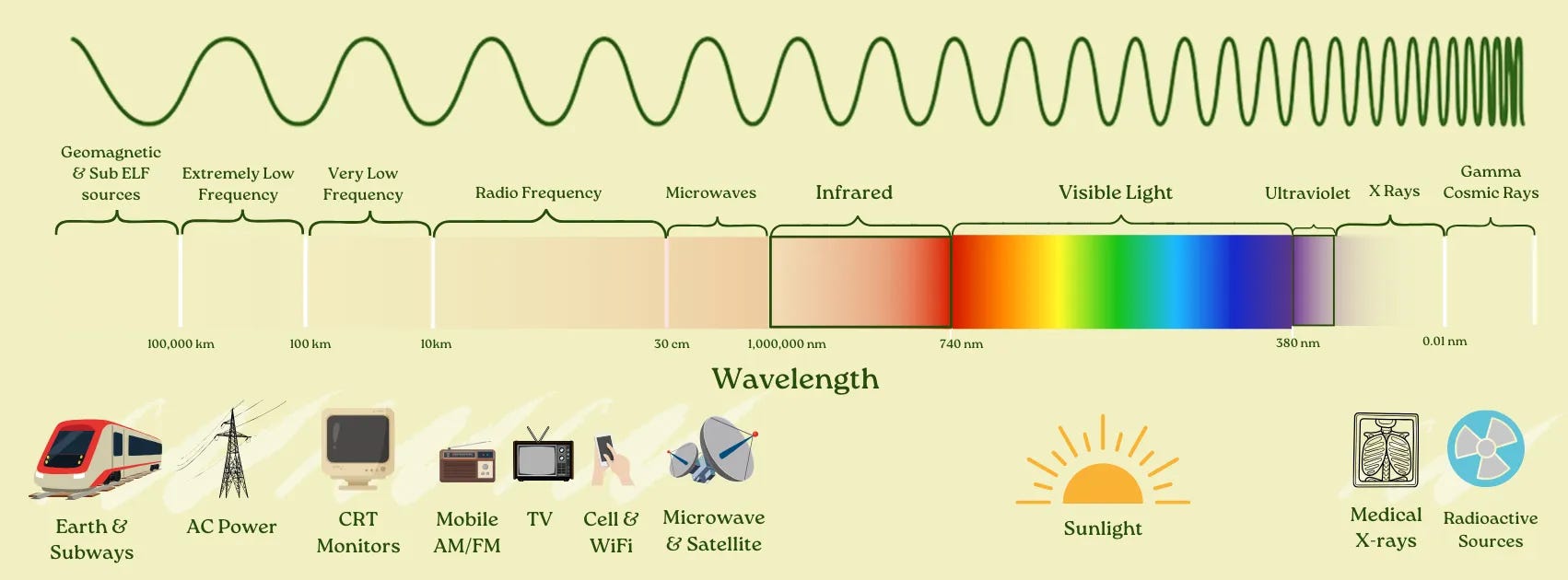
EMFs go from the Earth’s natural electromagnetic field, to AC power (what we use to power our homes) to radio, TV, cell phones, microwaves, satellites, infrared, visible light, ultraviolet light, x-rays, and gamma rays — and lots in between.
If you walk away from this article with nothing else, let it be this:
All of these are EMFs.
And EMFs, it turns out, do a whole lot. Some of it is really, really good — like letting us see! Or allowing us to communicate over distance! Or powering our houses! Or helping us diagnose broken bones!
But, as with most any technology, EMFs can also be bad depending on the dose and the exposure.
X-rays let us see broken bones — but in too high a dose can cause cancer.
UV light exposure helps us produce critical vitamin D — but can give us sunburns.
Power lines deliver us electricity — but can shock us.
Microwaves can heat our food — but without proper shielding can burn us.
Gamma rays are used for targeted cancer treatment — but can also cause cancer themselves.
All that to say: same as every other technology, we need to be mindful about EMFs. We’re careful with knives (despite them being life-changing for food prep), the internet (despite it changing the fabric of human civilization), and the wheeled vehicles (despite them shifting the trajectory of humanity). EMFs are no different.
There are categorically two ways that any EMF could in theory cause harm to a biological system (like our bodies): through ionizing effects or through non-ionizing effects.
Ionizing EMFs
I’m going to briefly cover ionizing radiation first, but then we’ll focus on non-ionizing effects — because that is where the current controversy lies, and where we need to be better equipped to understand.
Ionizing means that when a super high energy photon (from a high-frequency electromagnetic wave) “hits” something, it can knock out electrons from that atom or molecule, creating chemical changes and potentially severe biological damage. Think of ionizing radiation as a bullet that can hit cells with a lot of force, leading to mutations and cancer.
Things like x-rays and gamma rays fall in this class of ionizing EMFs: both are made up of really, really high-frequency waves. Really, really high-frequency waves means really, really high energy photons. And really, really high-energy photons means potential cellular or DNA damage if they hit you. This is why too much x-ray exposure can make you sick, or -- in the case of Marie Curie -- literally radioactive at time of death (hence her burial in a lead coffin).
Yikes.
Here’s the comforting part, though: most EMFs are what’s called “non-ionizing.” This means that their frequencies are low enough that their photons simply don’t have enough energy to do ionizing damage.
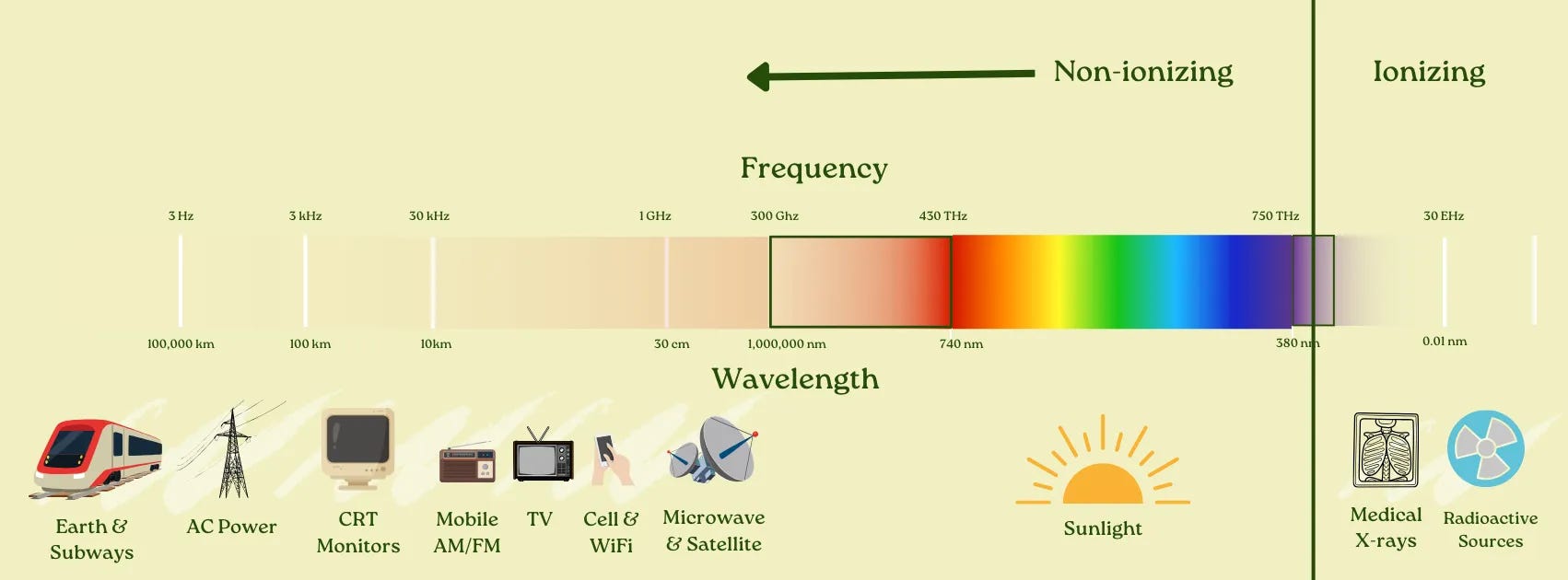
Scientists draw the ionizing vs. non-ionizing cutoff at about 125 nm wavelength (although it depends on the exact type of matter it is interacting with). Waves at a lower frequency (or a higher wavelength) aren’t ionizing.
Ionizing waves include the very high-frequency end of ultraviolet light (part of UV-B and all of UV-C light) and everything above that — including x-rays and gamma rays.
Here’s an imperfect but useful analogy: imagine you were in the ocean and waves were hitting you. But now, let’s imagine that you somehow heated up the water molecules in those waves a lot. It doesn’t matter how tall or short the waves are — at some point when the water molecules get hot enough, you’re going to have a problem. You could be facing the lowest-intensity physical waves, but if the water is boiling (read: the EMF photons have enough energy), you’ll suffer.
Electromagnetic radiation is much the same way. The heat of an ocean wave’s particles is somewhat analogous to the photon energy of the field’s photons. Thankfully, below a certain temperature, the heat component of a wave just won’t bother you — might even feel nice! And similarly, below a certain photon energy (and correspondingly below a certain frequency), an electromagnetic field just can’t ionize you.
So for ionizing electromagnetic fields (like x-rays and gamma rays), everyone agrees: be careful. This is why we’re careful with radioactive waste; why you get protection when getting an x-ray and the technician often leaves the room; and why certain extreme parts of the UV spectrum can cause health issues.
But to what, then, can we analogize the other ways an ocean wave could hurt you?
Non-ionizing EMFs
Beyond our burning water example, I’d say there are two ways an ocean wave can hurt you: a really intense wave can hammer you physically, or a specifically-shaped wave can disrupt an otherwise finely-calibrated system (like by getting water in your eyes, or down your windpipe).
I think of non-ionizing radiation in the same way. Mostly fine and lovely. But if it can harm you, it does so through one of two ways: either a lot of intensity causing a “smack” (in science terms, in the case of EMFs this is what’s called “thermal effects” — we’ll get back to this), or a disruption of a system in your body (we’ll get back to this too).
Let’s look at an example of each of those types of non-ionizing radiation that could cause you harm.
Non-ionizing but thermal
In the 1940s, a American scientist named Percy Spencer stumbled upon the realization that electromagnetic waves could heat things up. The story goes that he was building magnetic equipment for the US World War II effort and a candy bar in his pocket melted thanks to the generated waves. He (via his employer, Raytheon) went on to patent the microwave oven in 1945, although it took a couple more decades before an affordable consumer version was produced.
Microwave ovens use micro-waves — electromagnetic radiation with wavelengths around 12.5cm and frequencies around 2.4Ghz (that’s giga-Hertz, and could also be written as 2,400,000,000 Hertz). They do so because this type of radiation is extremely effective for heating up water molecules.
It’s pretty obvious that if you put your body in a microwave oven, it would not be a pretty picture. They are extremely effective at heating up organic (water-containing) tissue, like our bodies.
Clearly, these waves could cause you harm — imagine your insides heating up the same way a piece of pizza does. That’s because the waves inside the ovens are at such high intensity — and that’s why microwaves are shielded.
Over the course of history, our understanding of the potential harm of electromagnetic fields has evolved. For a long time — starting in the 1800s when all this was discovered — our broad scientific understanding was that the only way an electromagnetic field could directly hurt you was if it was ionizing. We knew x-rays and gamma rays could be harmful. But we established that everything else below that range — anything starting in the ultraviolet range or below — was safe.
But over time, we started to realize that wasn’t quite true (in part because we hadn’t built really powerful & intense electromagnetic systems yet). It took until the mid-1900s and the creation of the microwave for us to realize that there was a non-ionizing way that EMFs could cause harm: thermal effects!
Even then, it really took until the 1980s for this to get recognized from a regulatory and mainstream perspective. Until then, the consensus was “ionizing = bad; non-ionizing = fine.” But by the 1980s, we added another category of harm: ionizing was definitely still bad, thermal effects could be bad, but everything else was still definitely fine.
And weirdly enough, that seems to be the general popular stance even today: if an EMF isn’t ionizing or causing thermal effects, it must definitely be safe.
But I, honestly — after doing all this research into this — don’t really understand how anyone who has thought deeply about the subject can believe that. And it goes back to one of the categories I mentioned above: how a specifically-shaped ocean wave can disrupt something in your body even if the wave isn’t boiling hot or super intense (like getting water down your windpipe).
Non-ionizing but disruptive
Here’s a dead-simple example: blue light.
Blue light is, as we’ve been talking about, an EMF. It’s an electromagnetic wave with a wavelength around 440nm and a frequency around 750 THz — well below the ionizing threshold.
But blue light is known to be harmful for our sleep quality and Circadian rhythm! That’s why using your computer or phone late at night can make it hard to sleep. This is well-established and I’ve never heard anyone well-informed argue that blue light has no negative effects.
It’s bad for you, but it’s not because it is ionizing radiation, nor is it high enough intensity to have thermal effects. It disrupts a very finely-attuned system in your body: your visual system, which has evolved to expect blue light only in certain situations (namely: when the sun is up).
So, clearly, non-ionizing and non-thermal EMFs can have negative effects. I’m certainly not saying they all do. But I’m simply pointing out that this public view that EMFs are safe if they don’t heat you up or ionize you may be worth reconsidering.
So now we understand that EMFs can cause damage in one of three ways:
High-enough frequency EMFs (the high end of UV and above) are ionizing, causing cellular and DNA damage. Think x-rays, gamma rays, etc.
Certain EMFs at high enough intensity can cause thermal effects, heating up tissue and causing damage. Think microwaves, heating you up.
EMFs could hurt you in other ways, by disrupting specific systems in your body. This is the controversial part 😉
So, again, like an ocean wave: it could be heated up and burn you regardless of intensity (case #1), it could be really tall and intense and physically hurt you (case #2), or it could hit you in just the right way — imagine a tall, skinny, not-intense wave splashing into your face — to hurt you another way (case #3).
But I’ll advance this even a step further before getting to “so what.” Because there are at least a few other factors that could impact if a wave hurts you, beyond the characteristics of the type of wave (wavelength & frequency) and the intensity (amplitude).
First: the duration or pattern of exposure to the wave. Sure, one medium-intensity ocean wave might not hurt you. But if you stood and got smacked identical waves for 8 hours? Might start to hurt. The cumulative “damage” from the waves could be real. The same could be true for the “system disruption” case — maybe one wave is fine, but after an hour of them, you’ve got salt water in your eyes and it really burns.
And second: your individual sensitivity. Maybe a certain ocean wave doesn’t have any negative impact on a 6-foot-tall, 200-pound person — but that same wave could send a baby flying. Or it could even knock over a taller, thinner person. Or it could take out someone of the same size, but who has worse balance. Or maybe someone has open wounds on their body and regardless of their size, the wave really hurts them.
And of course, electromagnetic waves are much the same.
All this to say: to properly evaluate the impact of an EMF on a biological system (like our bodies), you need to think about at least four things:
the characteristics of the wave type (wavelength, frequency)
the intensity of the wave (amplitude)
the duration or pattern of exposure
the individual sensitivity
This is — by the way — not such a crazy thing to do. Just think about sunlight! It’s an EMF. And when you’re assessing the potential for sun damage, you’re thinking about:
What time of day is it? (Early morning & evening means a lower proportion of high-frequency UV light, thus lower risk for sunburns relative to midday. This is you — without even knowing it — thinking about the characteristics of the wave type, like frequency)
How bright is it given where I am and the time of year? (This is you considering the intensity of the wave)
How long am I going to stay out? Have I already been out a bunch today? (This is you looking at the duration or pattern of exposure — more exposure means more risk)
How sensitive am I to the sun? (We all know we have different individual sensitivity, and take that into account)
When you look at it that way… maybe not so unreasonable for us to take a nuanced view on other types of EMFs, too.
And the questions you might be asking now are: these 5G towers going up — are they bad or is that all fiction? What about big power lines? And is having our Bluetooth, WiFi, and cell-service-enabled phones in our pocket a problem?
After doing a whole lot of research, it’s clear to me that the health impacts of EMFs are severely underrated by the general public and media.
Nobody is disputing that x-rays or gamma rays are harmful. But the popular public narrative is that everything else is fine.
However, there’s significant, compelling evidence that radiofrequency EMFs — like those from WiFi, Bluetooth, and cell service — and even ELF (extremely low-frequency) EMFs can be harmful. And that flies in the face of the public narrative.
See, for example, Dr. Henry Lai’s review of about 2,500 studies on radiofrequency and extremely low frequency EMFs conducted between 1990 and 2024. He found that 70-90% of the studies reported significant effects across oxidative stress, genetic effects, neurological impact, and reproductive/development issues.
I often hear people say “there’s zero evidence that those EMFs are harmful!” But I find it hard to look at Dr. Lai’s review of 2,500 studies and come to that conclusion.
Or look at the United States’ National Toxicology Program’s 2018 report. After a 10-year, $25MM study on radiofrequency radiation, they found clear evidence of an association with tumors in the hearts of male rats, and some evidence of an association with tumors in the brains and adrenal glands of male rats. And this was from 2G and 3G radiation — not 4G or 5G, which are both higher frequency.
This was the first public US government study into the health impacts of radiofrequency radiation since the 1990s (and clearly wireless technology and exposure has changed a lot since that time). The FDA asked the NTP to conduct this study in May 1999 (19 years before it was published), saying in part:
Currently cellular phones and other wireless communication devices are required to meet the radio frequency radiation (RFR) exposure guidelines of the Federal Communications Commission (FCC), which were most recently revised in August 1996. The existing exposure guidelines are based on protection from acute injury from thermal effects of RFR exposure, and may not be protective against any non-thermal effects of chronic exposures
In my view, there is plenty of strong evidence today that consistent, repeated exposure to EMFs has negative health consequences. And as such, figuring out how you can mitigate your exposure is quite prudent. I do a few simple things:
I don’t hold my phone up to my head — earbuds or speakerphone only
I try not to keep my phone in my pocket — when I sit down, put it on the table
I use wired headphones instead of wireless, and turn Bluetooth off
I use wired peripherals for my computer instead of Bluetooth
I turn WiFi off at night (actually, I’ve hardwired my house with Ethernet so I don’t need WiFi at all)
Because of the nature of electromagnetic fields, even a small amount of distance can create a huge reduction in exposure (thanks to the inverse-square law).
Will taking those actions make a meaningful difference in my life and health? I don’t know. But they are easy to do, and I think worthwhile given the evidence I have seen.
If you want to go deeper, I’ve also written posts on the flawed assumption at the heart of US radiofrequency radiation exposure, a very long one looking at the scientific literature about the health effects of these types of EMFs, and another one on lighting (a type of EMF!).
And if you’re curious to learn more about the health of your home’s EMF profile (and air, water, lighting, and more), check out Lightwork Home Health, which I co-founded to help people live in healthier homes!
***
Thanks Andy for writing! I personally have learned a lot talking to Andy about EMFs, and think taking precautions makes all the sense in the world. Let me know if you’d like me to go deeper on this topic!
😌 Dope stuff on the internet
Some of my favorite things since the last newsletter (note: I don’t get paid to recommend anything here):
📰 Article - This article tracked individuals in the Netherlands and showed just how many toxins and chemicals the average person is exposed to in a week.
I’ll say it again: the environmental toxin crisis of today is like smoking in the 50s. We are only now starting to see the health consequences of such intense toxin exposure, all which is a consequence of our insane approach to chemical regulation (which I wrote about here). I suspect avoiding these toxins are pretty much impossible. The best you can likely do is mitigate the common exposures, and do annual therapies (like Proxima) that can remove toxins from your body.📚 Book rec - I really enjoyed The Forever Strong Playbook by Gabrielle Lyon. She really knows what she’s talking about, and is a big believer in intentionally building muscle as one of the highest leverage things you can do for your health (I agree). To get a preview of her work and thinking, this podcast with Chris Williamson was also quite good.
⌚ Cool product - Levels + Toku are running a heart health challenge with the goal to lower ApoB markers among participants. I’ll be participating in this challenge myself!
🎵 Music - This Fred Again.. Dublin set is just fantastic. The video was even cooler, but they seem to have taken it down. 10/10 listen, as many of his live sets are.
🏀Random - I love my lightbulbs from healthy home shop so much, it makes travel hard 😂. Once you switch to red lights to wind down at night, the default bright white LEDs after 7pm feel more and more insane.
🔥Hot take - I am changing my mind on GLP-1s. As more and more evidence comes out, it seems like the newer drugs (retatrutide, tirzepatide) are wildly beneficial, especially when used in small doses. Additionally, the US is in the midst of a record-setting chronic disease crisis: maybe we do need to technology our way out of this, and then work towards an environment that’s default health-promoting. Until then, I’m increasingly bullish on the risk/reward of these compounds being wildly favorable for those looking to treat or reverse obesity.
🙋♂️ Ask - I’m looking for a freelance researcher who I can hire to dig into historical health mysteries. For example, it appears that people used to consumer more calories (and perhaps had higher baseline metabolic rates?), and that there’s a long history of thyroid interventions driving tremendous behavioral and body changes. It’s all interesting, and I’d love to work with someone to explore further!
***
My goal (after a crazy Q4 with Truemed and a new daughter!) is to get back to writing these more consistently. If you have topics you’d like to see me dig into, let me know! Otherwise, enjoy the month 💪
Justin
hi andy!!! yes, EMFs are the invisible toxin that people will start to care wayyy more about in the coming years. and yes, detoxification will also blow up in the next 3-5 years because of the overwhelming toxic load we're exposed to on a daily basis.
i'm glad this is my life's work and am just about to start building a company to bring it mainstream.
Hi Justin, happy to help on the research front. Let me know what's the best way to connect for you and move this forward.